

Thomas Merton: A Second Course
Introduction

Hello everyone,
Readers of this column may remember that its origin in 2023 was to prepare a course about Thomas Merton for the Worcester Institute for Senior Education (WISE) at Assumption University in Worcester, Massachusetts.
The course has been completed and was well received. I am grateful. Several participants suggested to me a second course which would examine Merton’s writing in more detail. Since most readers of Merton are more familiar with his prose writing than his poetry I am beginning preparations for a second course which will feature his poems and poetic thought. The working title of the course is “The Poetical Influences on Thomas Merton’s Poetry, Politics and Spirituality.”
Merton demonstrated a vivid interest in writing poetry and wrote prolifically about poetry and the use of language. The anthology of Merton poems runs more than a hefty thousand pages.
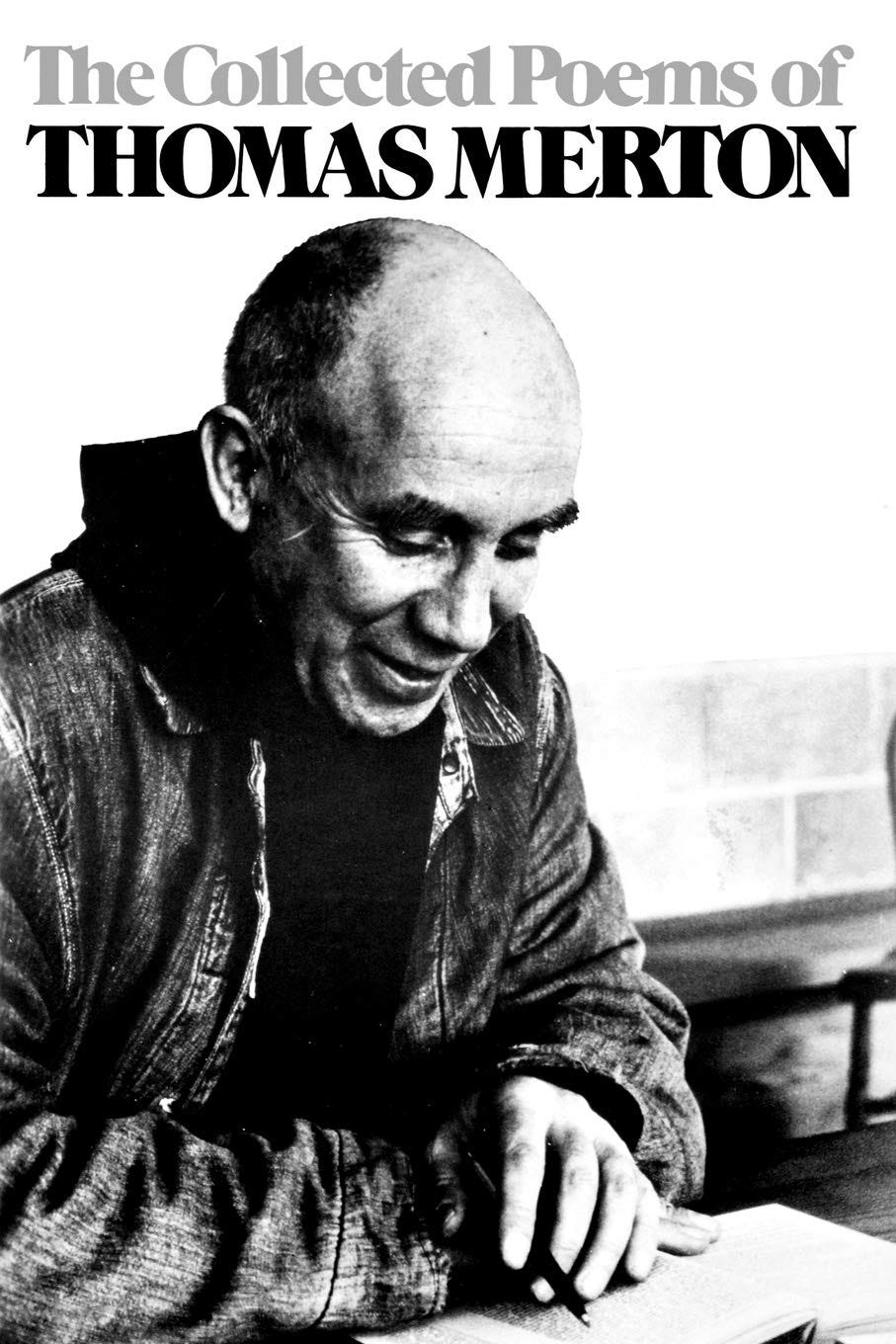
It is easy to understand Merton’s interest in poetry. At Columbia in New York City he wrote his master’s thesis “On Nature and Art in William Blake” at Columbia. While there from 1935 until 1939 several poets influenced Merton, most notably his professor, Mark Van Doren, and fellow student, Robert Lax. Both of these people would be life-long friends.
In the 1960s he became interested in the work of the Catholic poet Daniel Berrigan who was a Jesuit priest. Since Merton was born in France he had an interest in the French poet, Saint-John Perse, who was awarded the Nobel Prize for Literature in 1960. In the decade of the 1960s Merton was influenced by several Latin American poets from Brazil, Argentina and Peru.
My initial plan is that this course will compare Merton with these poets and exam the influence these poets had on Merton’s writings, the political landscape of the 1960s and Merton’s expression of spirituality through poetic language.
In February 1964 Merton sent a message1 to a spontaneous meeting in Mexico City of the “new” young poets of Latin America. Merton wrote that “We who are poets know that the reason for a poem is not discovered until the poem is written.” Here Merton points to one of the differences of prose from poetry: prose is planned while poetry is inspired. Muses rarely analyze. Writers who have exceled in both genres know a wise poem takes a lot longer to write than an insightful essay. Or as Philip Murray expressed it; “A good couplet will outlast a bad epic.”2
Remember, however, that Merton’s love of poetry resides in its association with a spiritual realm which can be appreciated with this comment from a book review in 1967; “All really valid poetry (poetry that is fully alive and asserts its reality by its power to generate imaginative life) is a kind of recovery of paradise.”3 It is reminiscent of Jorge Luis Borge’s remark; “I have always imagined that paradise will be a kind of library.”
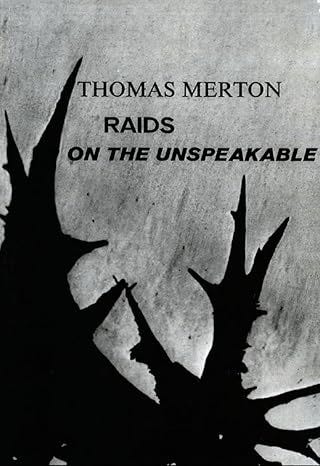
One reason Merton’s writings are still read today is that many of his observations resonate with us even more now than when Merton wrote them. Consider one of the the comments in that letter to the poets of Latin America; “We believe our future will be made by love and hope, not by violence or calculation.” Sounds like a recent political refrain. The essays in this short collection reveal a more practical and direct observation of a stark world Merton did not even live in. Even the cover illustration which tries imagine the unspeakable is Merton’s own.
Boccaccio, the Italian poet, in his work Genealogy of the Gods, written in1363, seems to have described Merton quite well. Boccaccio wrote that “Poets prefer to dwell in solitude.”
Merton’s review of the poems of Louis Zukofsky in The Critic, February-March 1967, “Paradise Bugged.”
Philip Murray, Poems After Martial, 1967.
Thomas Merton, “Message to Poets“ in Raids On The Unspeakable, pages 165-161.